 ToolNest
What Is the Dark Web?
Myths vs Reality
When people hear “Dark Web”, they imagine hackers in hoodies, illegal markets, and hidden corners of the internet. Movies and news have painted it as a digital underworld.
But how much of that is true?
In reality, the Dark Web is neither purely evil nor something magical. It’s simply a private, encrypted part of the internet—and like any tool, it can be used for both good and bad.
Let’s separate myths from reality.
🌐 Understanding the Internet Layers
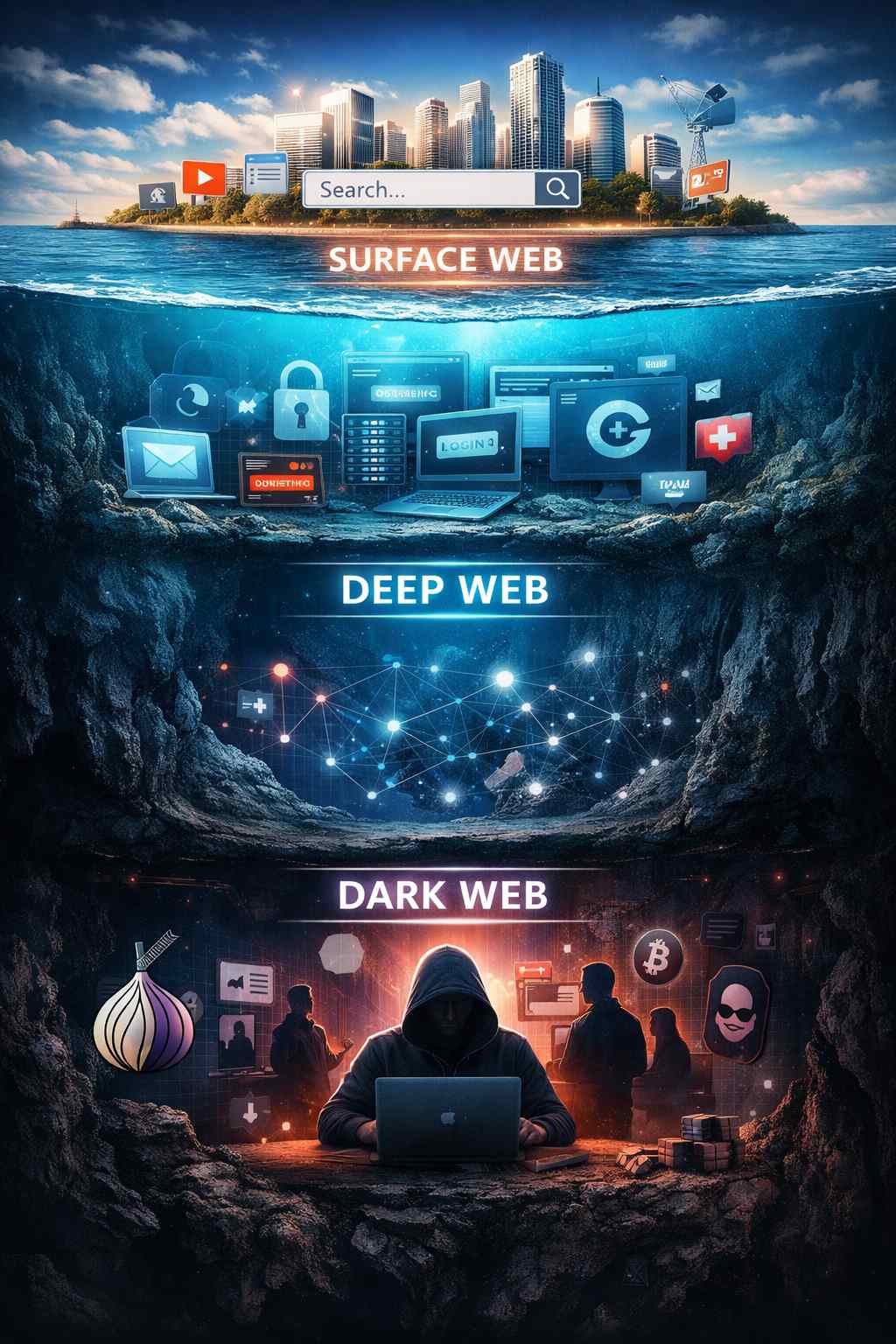
The internet has three main layers:
-
Surface Web – Google, YouTube, news sites, blogs.
-
Deep Web – Private content like emails, bank dashboards, cloud storage.
-
Dark Web – Encrypted networks accessible only with special software (like Tor).
The Deep Web is not the Dark Web.
Your Gmail and bank account are part of the Deep Web, not the Dark Web.
🧠 Myth #1: “The Dark Web Is Illegal”
Reality: The Dark Web itself is not illegal.
It’s just a technology that allows:
-
Anonymous communication
-
Censorship-resistant publishing
-
Privacy-focused browsing
Journalists, activists, whistleblowers, and even governments use it to:
-
Share sensitive information
-
Bypass censorship
-
Protect identity in hostile regions
Illegal activities exist there—but that doesn’t make the entire network illegal.
🕵️ Myth #2: “Only Hackers Use the Dark Web”
Reality: Many normal people use it for legitimate reasons:
-
Journalists protecting sources
-
Citizens in censored countries
-
Researchers studying cybercrime
-
Privacy-focused users
It’s like saying “Only criminals use VPNs.”
The tool is neutral. The intent matters.
💀 Myth #3: “You’ll Get Hacked Just by Opening It”
Reality: Simply accessing the Dark Web doesn’t automatically infect your device.
The real dangers come from:
-
Downloading unknown files
-
Clicking shady links
-
Trusting random marketplaces
-
Disabling security settings
Just like the normal web, unsafe behavior creates risk.
⚙️ How the Dark Web Works (Simply)
The most common gateway is Tor (The Onion Router).
Tor:
-
Encrypts your traffic
-
Routes it through multiple nodes
-
Hides your IP and location
Websites on Tor end with .onion and are not indexed by Google.
This makes:
-
Tracking difficult
-
Surveillance harder
-
Privacy stronger
⚠️ Real Risks You Should Know
The Dark Web is not a playground. It has real dangers:
-
Scams & fake marketplaces
-
Malware-infected files
-
Phishing traps
-
Law enforcement honeypots
There is:
-
No customer support
-
No refund
-
No safety net
One mistake can cost data, money, or privacy.
🧭 The Truth
The Dark Web is:
-
❌ Not a magical hacker universe
-
❌ Not illegal by default
-
❌ Not instantly dangerous
It is:
-
A privacy-first network
-
A tool for freedom of speech
-
A space with both light and dark sides
Like fire, it can warm a home—or burn it down.
Final Thought
The Dark Web isn’t evil.
It’s powerful.
And power always depends on who holds it.
Understanding it makes you:
-
More cyber-aware
-
Safer online
-
Better informed
Fear comes from mystery.
Knowledge replaces fear with control.